
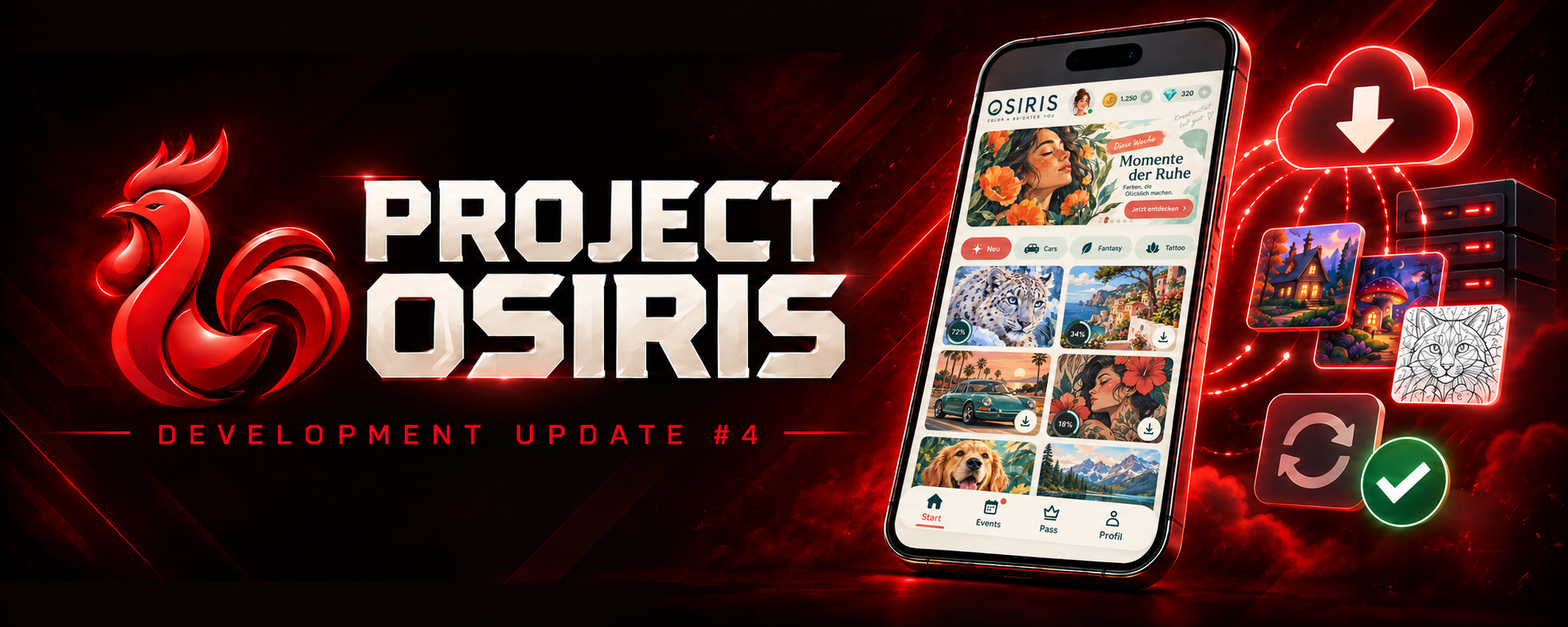
Alongside the technical development, we have also made major progress on the user interface of Project Osiris.
While the previous screens served their purpose, they still looked and felt like an early prototype. We therefore created a new visual direction designed to feel more modern, polished, and suitable for mobile devices.
The areas being improved include:
the presentation of image cards,
spacing and sizing within the artwork grids,
highlighting selected sections,
button design,
the arrangement of content in portrait orientation,
and the overall visual hierarchy of each screen.
One of our main priorities has been the bottom navigation bar.
The New Bottom Navigation
The bottom navigation should look consistent across all major sections and always make it clear where the player currently is.
The updated design uses clearer icons, larger touch areas, and a visible highlight for the active section. This makes Project Osiris much easier and more intuitive to use on a smartphone.
The new design is currently being transferred step by step to the different screens, including:
the home screen,
the event overview,
the player profile,
and other central areas of the app.
For the first time, the individual sections are beginning to feel like parts of one connected interface rather than separately designed test screens.
Project Osiris on a Real Smartphone
Another major milestone is our first functional Android version.
Internal version 0.1.0 was successfully created, installed, and tested on a real smartphone. This allowed us to experience the existing flow outside the Unity Editor for the first time:
launching the app,
navigating through the different sections,
browsing categories,
opening an image,
coloring individual regions,
saving progress,
continuing unfinished artwork,
and viewing completed images in the profile.
The app is already running very reliably on our test device. This test also allowed us to evaluate spacing, card sizes, scrolling areas, and navigation from the perspective of an actual smartphone user.
Project Osiris is therefore no longer only a prototype inside the Unity Editor. It now exists as an installable and playable Android app.
Downloadable Images and Events
At the same time, we have built a system for external content.
The app can now process a remote catalog that defines which images and events are currently available. Our first test catalog contains two images, one event, and its own content-version number.
When Project Osiris starts, it can check which content is available. The downloaded catalog is cached locally and can be used again during future sessions.
If the server is temporarily unavailable, the app can fall back to the most recently cached or locally included catalog. This is intended to keep Project Osiris reliable even when the internet connection is unstable.
In the future, this system will allow us to provide new artwork, categories, and events without permanently including every piece of content in a completely new version of the app.
Content Is Loaded Only When Needed
We are using Unity’s Addressables system for the actual gameplay files.
An image consists of much more than its preview. Several files are required for the coloring experience:
the original full-color artwork,
the line art,
the region map,
the color information,
the individual coloring-region data,
and the preview used in the catalog and profile.
These files can now be loaded specifically when the player needs a particular image. Content that is no longer being used is released again so that it does not occupy unnecessary memory.
The profile can also load the required full-color image for completed artwork when needed and release it correctly afterward.
This creates the foundation for a much larger image library without permanently storing every future piece of artwork inside the original app.
A Growing Selection of Artwork
Our production process for new images has also been expanded.
We are currently preparing artwork for several categories, including:
Cars,
Fantasy,
Tattoo,
Gaming,
Movies,
and TV Series.
We are developing and testing different visual styles and production workflows for these categories. Our goal is to offer a varied collection while ensuring that every image still fits Project Osiris and can be converted reliably into a playable color-by-number experience.
A beautiful original image alone is not enough. Each piece also requires suitable outlines, clearly defined areas, a balanced color palette, and a region structure that remains enjoyable to color on a smartphone.
Our Next Step: Smarter Storage Management
Downloadable content introduces another important challenge: storage space on the device.
While an image is being colored, the app requires its complete gameplay package, including the line art, region map, color data, and additional files.
Once the image has been fully completed, many of these files are no longer required. Project Osiris should therefore be able to remove the gameplay package of a completed image from the device.
The final full-color image will remain available so that it can still be displayed in the player’s profile and personal collection. The larger coloring data will no longer need to occupy permanent storage space.
This will allow the collection to continue growing without every completed image using unnecessary storage on the smartphone.
What Comes Next?
Our upcoming development work will focus on:
transferring the new UI design to all important screens,
further improving the bottom navigation,
automatically removing gameplay packages that are no longer required,
optimizing download and storage management,
continuing tests on real Android devices,
creating new artwork for the prepared categories,
introducing additional event content,
and further polishing the coloring experience.
With Update #4, Project Osiris has taken an important step forward.
What started as a local Unity prototype is gradually becoming a proper mobile platform for color-by-number content—with its own visual identity, persistent progress, downloadable artwork, events, and a growing personal collection.
There is still a great deal of work ahead of us. However, we can now experience Project Osiris not only inside the Unity Editor, but as a functioning app running on a real smartphone.
Thank you for following our journey and supporting Numb Chicken Studio! ❤️
See you in the next development update! 🐔
— Numb Chicken Studio